A workflow and responsibility map
Define the repository or delivery slice, acceptance criteria, task owners and decisions reserved for people.


AI Engineering
Connect coding agents to project context, defined tasks and delivery checks. We help your engineering team implement a workflow it can operate and improve.
Bring delivery time, quality and operating cost into the same review. Your team owns architecture and release decisions.
Informed by our internal harness and Devbus practice. Client implementation has its own agreed scope.
Email us with your current tools and one delivery problem you want to address.
A change may cross a repository, several agents and a release pipeline. Each agent needs relevant context, permitted actions and a clear task. Your team needs to know what changed, what was checked and what remains unresolved.
We help CTOs and engineering leads turn that coordination into an operating workflow. Start with one delivery problem, then agree the evidence that will show whether the change is useful.
A coding-agent harness is the working structure around an agent. It connects project instructions, task boundaries and tool access with tests, recorded handoffs and acceptance decisions.
The agent implements a defined change. The harness makes its responsibilities, results and review evidence available to the people operating the process.
We assess the current workflow where important constraints are unknown. If the task and acceptance criteria are already clear, implementation can be scoped directly.
The agreed work can include:
Define the repository or delivery slice, acceptance criteria, task owners and decisions reserved for people.
Connect project context and task instructions to permitted tools, working boundaries and recorded handoffs for the selected scope.
Connect relevant automated checks and CI steps. Define independent review, failure handling and the evidence needed for acceptance.
Document how your team starts work, reviews results, handles failures and changes the workflow. Agree responsibility for maintenance and model costs.
The scope names the integrations, deliverables and acceptance evidence. An assessment, an adoption experiment and an implemented workflow each have distinct outputs.
The workflow is shaped around your repository and team. A representative sequence makes the boundaries concrete.
Record the intended change, constraints and acceptance criteria before implementation starts.
Give the agent relevant project information and an explicit boundary for tool and repository access.
The coding agent carries out its task and records the result, checks performed and unresolved questions.
Automated unit, integration and regression checks cover the behaviour selected for the change. Failures return to the work queue.
A reviewer separate from the implementer examines the change and its evidence. Material findings return for correction and another check.
The responsible person reviews acceptance evidence and decides whether to release. Agents may execute deployment steps within an explicitly approved workflow.
Tests and independent review inform acceptance. People remain responsible for the release and its operating consequences.
We review the tools you already use before proposing changes. Model and hosting decisions depend on the task, data-handling requirements and integration boundaries.
Claude Code, Codex and Qwen Code are examples of coding tools we evaluate for the project. Where needed, vLLM can serve models and LiteLLM can connect model providers through a gateway. Selection depends on the workload, integration needs and operating constraints.
Compare hosted services and self-managed options against representative work. Include output quality, context needs, capacity, operating effort and total cost in the evaluation.
Our internal model-serving practice is a separate example of configuring dedicated hardware for specific workloads. It informs evaluation; your requirements determine the proposed setup.
Devmojos is a software studio based in Lisbon, Portugal.
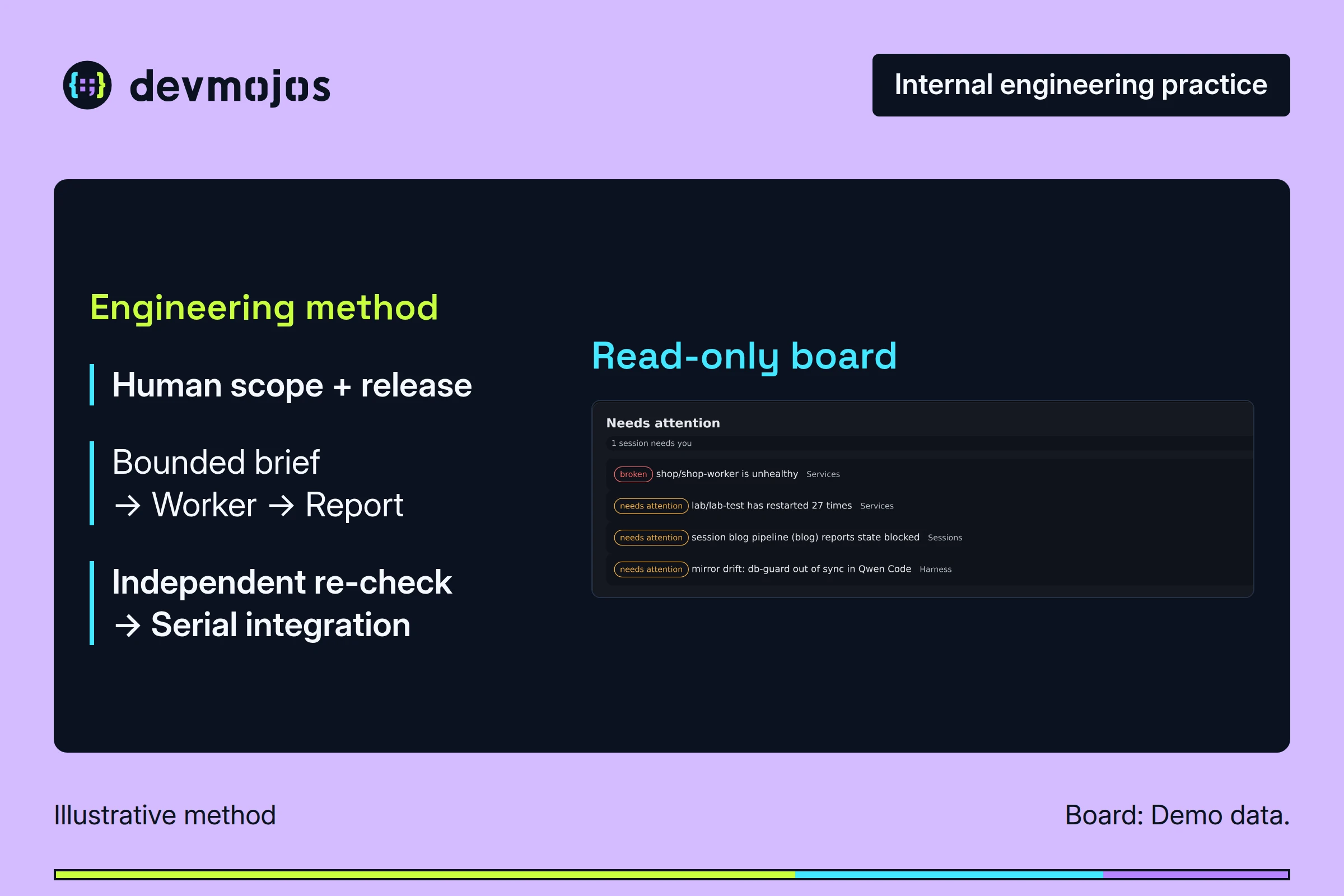
In our own delivery method, operator agents organise bounded work and coordinate coding agents. Devbus connects named agents and records communication and delivery state. The human delivery lead remains responsible for architecture and release.
The public harness illustration and demonstration use fictional data. They explain the method; they are not customer results or a live view of client work.
Four-Eyes Delivery is separate research from May to September 2026. It is distinct from the current harness and Devbus practice.
Commercial work adapts the relevant approach to your team’s repositories, responsibilities and constraints. Integration, acceptance and continuing support are agreed for that engagement.
Agree a baseline and useful measures before extending the workflow. These may include review effort, rework, elapsed delivery time and model or infrastructure cost.
Use that evidence to decide what to retain, adjust or stop. Results depend on the codebase, selected tasks, tools and operating process.
This work sits within Devmojos AI Engineering. We also build software and intelligent business workflows, connecting architecture, implementation and continuing improvement around business goals.
Tell us what your team is trying to change, the tools it uses and the main delivery constraint. We can discuss a focused assessment or an implementation scope.
Agree the first deliverable and acceptance evidence before extending the work. Continuing operation and later changes have their own scope and commercial terms.
We begin with your current tools, repositories and delivery process. Tool changes are proposed where the scoped work and evaluation support them.
The scope defines what context an agent receives and which actions it may perform. Access boundaries, data handling and model-hosting requirements inform the implementation.
This is a scoped engineering service informed by our internal practice. We agree the workflow, integrations and handover for your team before implementation.
Your responsible human operator reviews the acceptance evidence and makes the release decision. Agents can perform approved deployment steps within that decision.
Email info@devmojos.com with one delivery problem, your current coding tools and any important operating constraint. We will discuss fit and the next useful scope.
Email us with your current tools and one delivery problem you want to address.